Agriculture
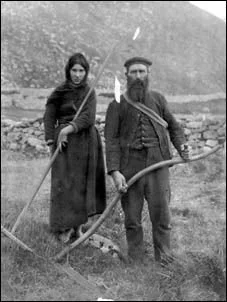
Finlay McQueen and daughter
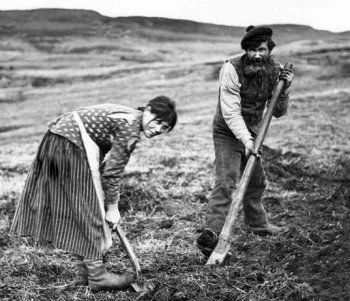
Plowing with a Caschrom or Foot-Plough
Hirta is an unusually green and fertile island, due to the large quantities of guano it receives from its bird populations. The soil, a rich though shallow loam, when properly managed, gave a good return on crops; but the climate with its harsh salt-laden winds restricted agriculture, within recorded history, to the most sheltered part of the island on the south-east of Village Bay. Although farming was a secondary occupation to fowling, the land provided a substantial part of the islanders’ diet and contributed a variety of produce towards the payment of the rent. All the arable land was contained within the village enclave and amounted to between fifty and a hundred cultivated acres, with a few more lying fallow.
The maximum acreage was never exploited, as the St Kildans were never anxious to put more land under cultivation since it would have meant a loss of pasture for their cattle and sheep, which they considered more valuable than crops.
Their arable land was divided into ten divisions and these then into sub-divisions with each family being allocated a certain number of these tiny fields.
The islanders first turned the ground with an aschrom (foot-plough), then went over it very carefully with a harrow, removing every stone, root and weed. Their harrows were homemade affairs, mostly of wood but with long tangles of seaweed fixed on behind to scatter the earth.
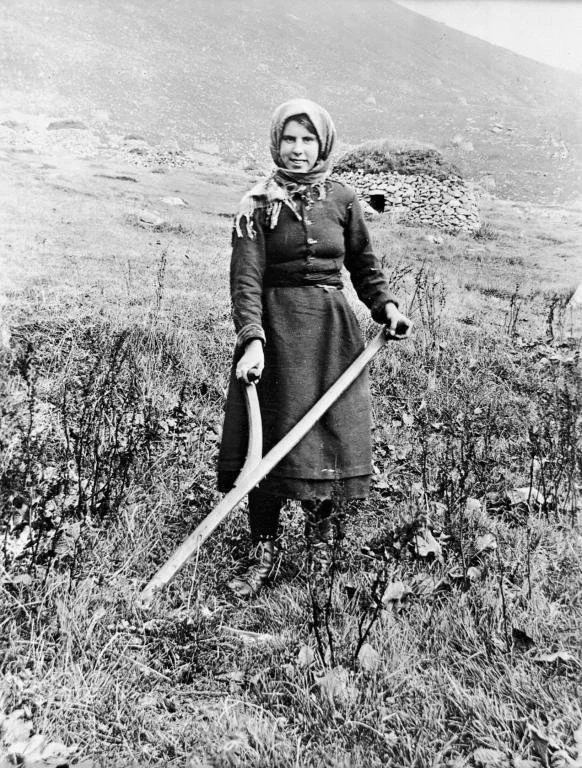
The main crop was barley, which matured quickly because the summers were short. It was imported each year as seed by the factor and when sown in April was usually ready for harvest by the 25th of August. The harvest always had to be gathered fast in case of storms, which at that time of year can be devastating. The moment the crop was ripe every able-bodied member of the community, including old people and children, helped to bring it in, sometimes working through the night to beat the weather.
The St Kildans also grew corn and oats but not as successfully as the barley, which for a long time had the reputation of being the finest in the west.