Cecilia an accomplished spinner and weaver
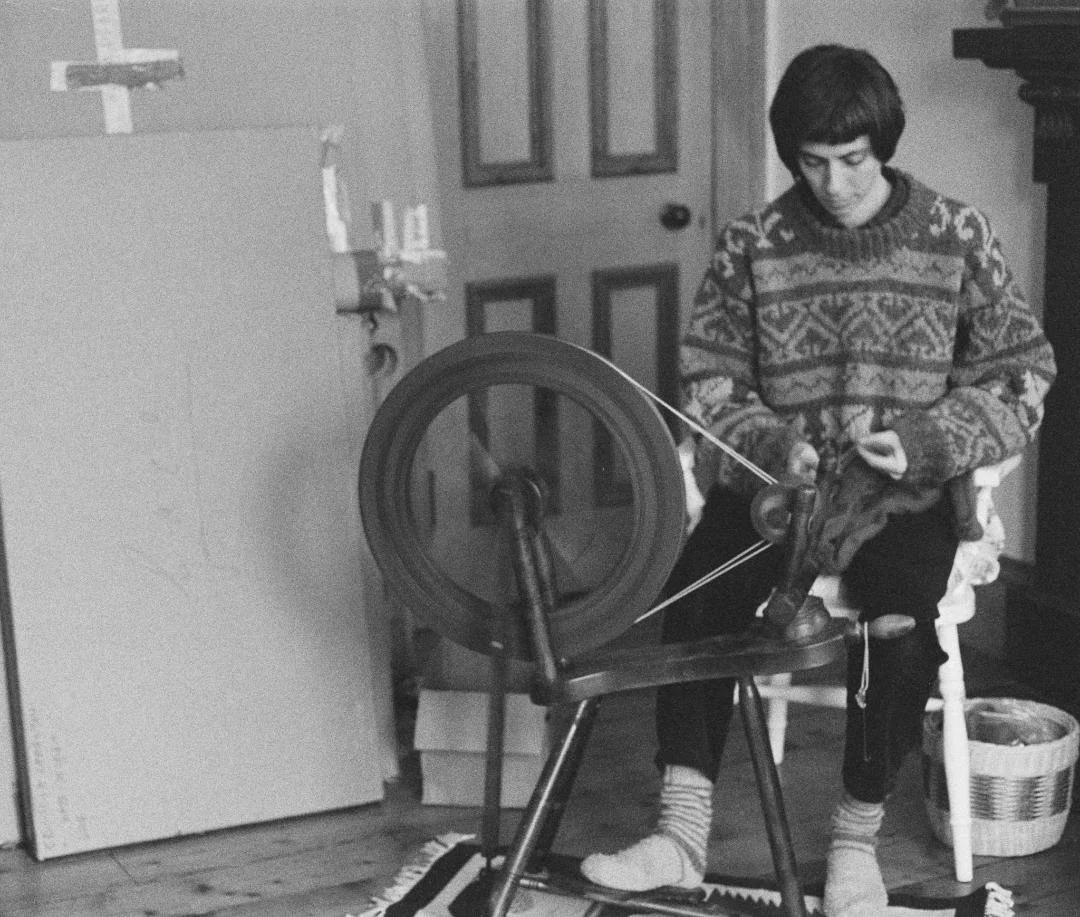
I would like to introduce you to Cecilia who I am hoping will be able to accompany me on St Kilda in 2027. She is not only an accomplished spinner and weaver but is presently doing a PhD under the current working title ‘Scotland’s Folk Weaving’: A Tradition Obscured by Mists and Myth’ focusing on the handmade, regional, pre-industrial textiles of Scotland. This research is part of a broader project to investigate, question and rewrite canonical, colonial, capitalist positions embodied in histories, technologies, and artefacts, and will be carried out in collaboration with National Museum Scotland (NMS).
Her response to a question I asked about her recent research into St Kilda tweed is as follows.
“It seems to me that the main thing about St Kilda tweed is its individuality. The carding, spinning and weaving all depended on the person who carried out each process, so the result of this is that each piece will be slightly different.
In terms of the sett -- I've checked my records, and the pieces I've seen range from 14 epi to 20 epi. So, there is no 'accurate' sett, as they varied depending on the preferences of the weaver, or potentially of the reeds that were available.
- the Boreray warp and Soay weft theory seems to pan out, probably not always (Boreray warp/ Boreray weft could also work)
- Singles yarn
- Twill weave
- either natural color of sheep or dyed with natural dyes
It seems to me that if these qualities are fulfilled then this is weaving as closely to 'St Kilda Tweed' as the St Kildans wove themselves. My sense is that within these parameters of materials and processes, each weaver wove slightly differently, and probably each fabric could be different even from the same weaver, depending on the quality of the sheep's fleece that year, or who did the spinning, or what color the crottal gave...
To me, this is the beauty of folk weaving. It is nearly impossible to recreate a product, or to fulfill exact specs -- and one doesn't need to try to. Each weaving reflects the moment, the seasons, living creatures, and our relationship to the landscape and natural world.
So far I've seen full fabric lengths at the West Highland Museum and the Highland Folk Museum. WHM was 18 epi twill with cream warp and reddish-brown weft, and HFM was 14 epi twill with cream warp and undyed brown weft.”