Fowling and its dangers
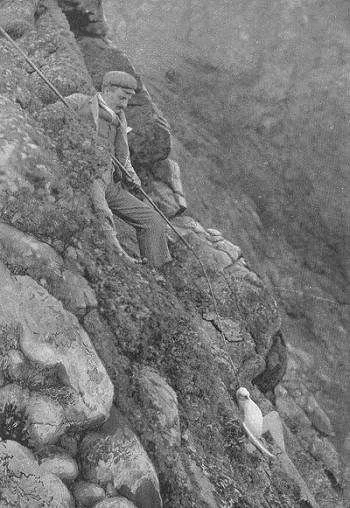
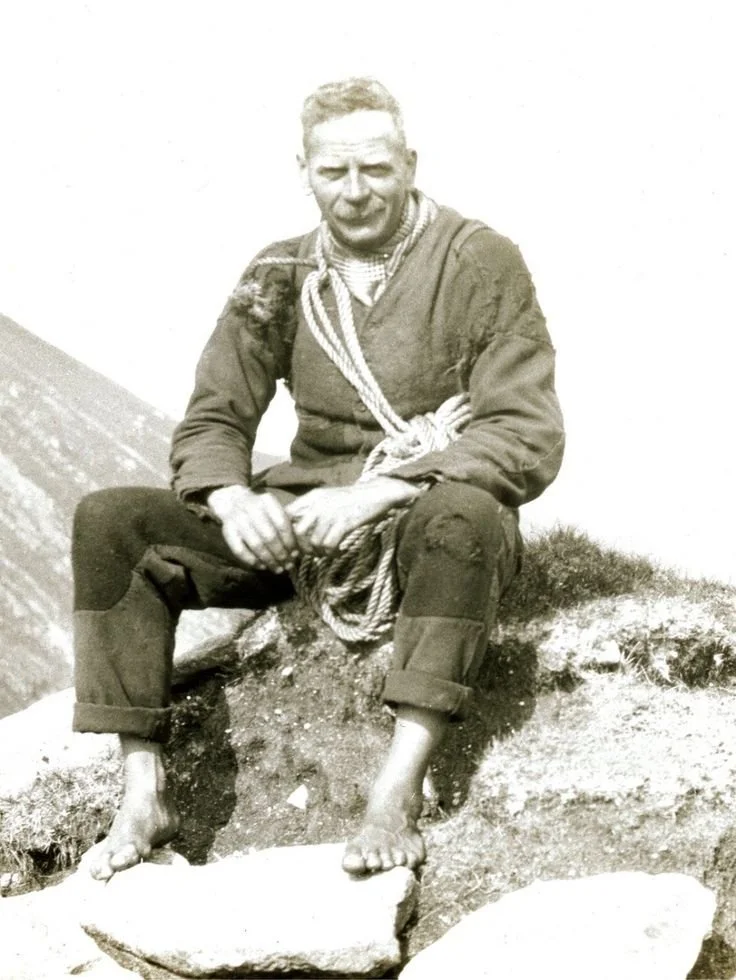
Fowling on St Kilda was an essential chore as the St Kildans diet was based on sea-birds and consumed in large numbers.
Fowling required a variety of skills ranging from an extensive knowledge of the behaviour of birds to a steady hand with the fowling rod, but no single ability was more essential than skill at the cliff face. If a man was no good at climbing, then he was no good to the island and most likely did not survive. By natural selection and early training, the St Kildan became skilful climbers to a man. The islanders grew up without any fear of heights. The young boys of three years of age began by climbing the walls of their houses and by the age of ten or eleven were receiving their education on the cliffs. At sixteen they were fully fledged cragsmen.
In the early days, except where specific co-operation was necessary, fowling was very much an individual pursuit encouraged by personal competition. The fowler would go off on his own with a rope and a stake, dig the stake in at the top of the cliff, attach the rope and lower himself down.
But first he would always make a careful examination of the ground at the edge of the cliff where his rope was to hang, making sure that it would not give way and that no loose stones could be dislodged by the movement of the rope. By working alone, he was sometimes able to reach more inaccessible parts of the cliffs, but he needed skill and strength to climb back up the rock with his catch and rod. If he ran into difficulties, he knew there would be no help available.
Sir Robert Moray wrote in 1678, “The men seldom grow old and seldom was it ever known that any man died in his bed there but was either drowned or broke his neck”.
Note:
As vegetation was scarce on St Kilda, horsehair was used to make the rope. Several strands needed to be twisted together. The more strands the tougher the rope