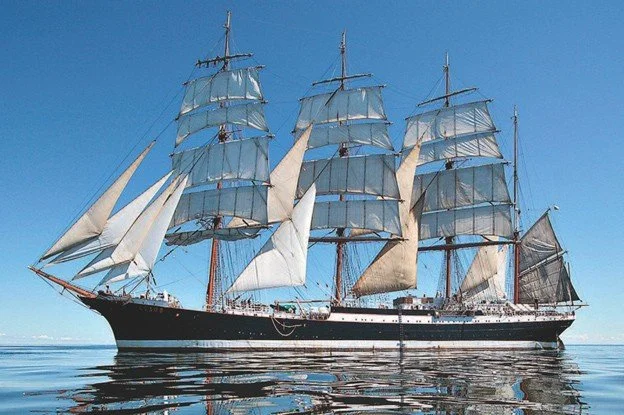
A Barque similar to the Priscilla
A Remarkable Connection
On the fifth Saturday of my six-week weaving course last October, my weaving teacher, Ilka, invited several of her former students to join our class for afternoon tea and to share examples of their work.
Ilka arranged around twenty chairs in a circle and invited us all to sit down together. I happened to choose a chair beside a woman named Sandra, who introduced herself by asking what had drawn me to weaving. As I began to explain my St Kilda Tweed Project, she almost fell off her chair. With evident astonishment, she told me that her ancestors were from St Kilda, having sailed to Melbourne aboard the barque Priscilla in 1852.
This was just one of many extraordinary and synchronistic connections that have unfolded since my journey began in earnest in June last year. These moments of coincidence and convergence have continued to gather momentum, culminating in the National Trust for Scotland granting me permission to stay on the Island of St Kilda for four weeks in 2027 to weave St Kilda tweed — the first time it will have been woven on the island in almost a century.
What follows is an essay written by Sandra for The St Kilda Mail, Number 13 (1989), after she was asked to describe her visit to the island in 1988 as a member of St Kilda Working Party Number 5.
From One St Kilda to another by Sandra Dexter
"When the Barque Priscilla sailed from Liverpool in 1852 bound for Melbourne there were thirty-six St Kildans aboard. Included in their number was one Malcolm McQueen, then aged Twenty-six.
Sadly, Twenty of the St Kildans died of fever on the voyage, but Malcolm was one of the survivors. His Great-Great-Grand Daughter visited St Kilda in 1988 as a member of the St Kilda working party number 5 and we have invited her to contribute a short account about her family and her visit."
"In Melbourne, Australia, St Kilda is an inner suburb (of some repute) and more importantly a football team in the Victorian Football League.
When I was seven years old I decide to change football teams from Collingwood to St Kilda. Was there a voice from the past urging me to change? More likely it was St Kilda's one point victory over Collingwood in the Grand Final! It was many years later that I learnt of my family's connection with another St Kilda. I borrowed a copy of Tom Steel's "Life and Death of St Kilda" and began to explore the history of my family and St Kilda.
Finlay and Christina MacQueen, their children Malcolm, Rachel and John left St Kilda in October 1852 for Melbourne. Malcolm is my great-great-grandfather. The 18-week voyage was a tragic one - of the 36 St Kildans aboard the barque “Priscilla" only 16 survived the journey. Nineteen year old Rachel MacQueen died on board and Finlay MacQueen died soon after arriving in the colony. The ship was quarantined for five weeks and some who had survived the voyage died in quarantine. It was a grim beginning.
Why did they leave? The "Pricilla" was commissioned by the Highland and Island Evacuation Committee who were set up to assist people in isolated communities affected by the potato famine to emigrate to Australia.
Australia needed workers to replace those who were flocking to the gold fields in Victoria and New South Wales. In his memoirs Malcolm MacQueen records that when they were leaving St Kilda the owner, Sir John McPherson McLeod, asked the emigrants what he could do to stop other St Kildans from leaving and they told him to give control of the manse and school to the Free Church to which the St Kildans belonged, instead of the Established Church. Inview of the St Kildans' strong devotion to the Church this seems an important factor in their decision to leave in 1852. No doubt the deaths of their friends on the Priscilla deterred any further would be emigrants to Australia.
Australia was a land of opportunity and growth in the 1850's. Gold was making the colony move and the building trade was flourishing. Malcolm, his uncle, Malcolm Ferguson, and Ewan Gillies found employment on building sites. Malcolm married Mary McSwain from Raasay and they had seven children. They tried living "outbush" in Northern Victoria working on sheep and cattle stations, where they would have found a dry, harsh and lonely land. They returned to Melbourne, bought land in Cheltenham and became market gardeners.
Malcolm's children, Reverend Finlay MacQueen and Christina MacQueen visited St Kilda in 1928. Shocked by the living conditions they tried unsuccessfully to persuade the St Kildans to return to Australia with them.
Malcolm's grandson and namesake studied Theology at Edinburgh University and visited S Kilda in 1913. And I, his great-great-grandaughter visited St Kilda in June 1988 on working party No. 5.
I'd hoped I might feel an immediate affinity with St Kilda. My first reaction.I must admit, was disappointment. Our crossing in the "Kylebhan" had been great. Long, light summer evenings are something we don't get in Melbourne and the voyage up to the Sound of Harris was peaceful and beautiful. I was too full of expectations and to arrive (with a whoosy stomach) at a grey St Kilda with Conachair hidden in cloud was an anti-climax. But the cloud lifted and I found a St Kilda that was green and wild, possessing an aura of isolation and independence - undaunted and stubborn against wind and sea.
Visiting the home of my ancestors was a great experience. It's a lonely, wild, wonderful place and I am glad it is protected and loved by so many so that more people can experience the uniqueness of St Kilda."