The St Kildan weaving tradition
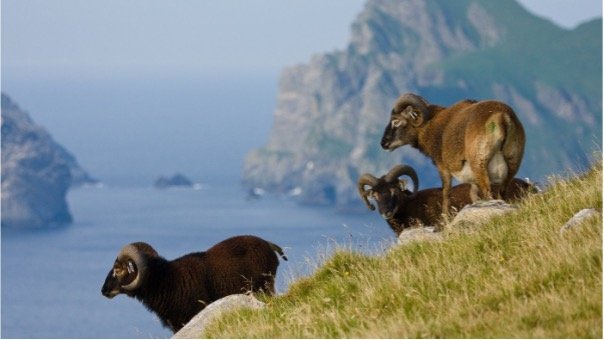
Soay Sheep
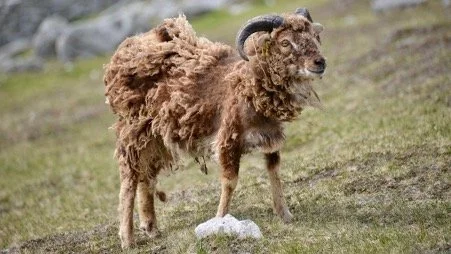
Boreray Sheep
St Kilda had two distinct primitive sheep populations, both Northern European short-tailed breeds that naturally molt (they were rooed or plucked by hand rather than shorn, a low-tech method suited to the terrain and breeds):
• Soay sheep (weft yarns): Native to the separate islet of Soay (owned by the laird). Small, dark brown with darker flecks, extremely hardy and feral. Their wool provided warmth, softness, and the characteristic brown tones/flecks in the finished cloth. After evacuation, some Soay sheep were moved to Hirta and remain there today as a famous feral population.
• Boreray sheep (also called Boreray Blackface or Hebridean Blackface; warp yarns): The islanders’ own flocks, kept on Hirta and Boreray. Larger, mostly white/cream fleece that was coarser and stronger. This provided the warp’s durability. The wool was rough-textured and historically used for tweeds and carpets.
Some accounts describe the islanders’ sheep as “black-faced interbred,” but fibre analysis of surviving tweed confirms the Boreray/Soay split: cream-coloured Boreray warp for strength + brown Soay weft for warmth and colour. The combination gave the cloth its distinctive natural, flecked appearance without artificial dyes.
St Kilda’s weaving and spinning tradition was a vital part of daily life and economy on the remote archipelago (primarily Hirta, the main inhabited island) until the 1930 evacuation. The islanders produced a distinctive, rustic tweed from the wool of their own sheep flocks, using hand-spun single-ply yarn woven on domestic looms. This was one of the few cash-generating activities alongside seabird harvesting, and it supplemented their subsistence lifestyle. Wool work was highly gendered: women handled spinning (and often carding), while men did the weaving as a winter occupation. Every household had both a spinning wheel and a loom.
The tradition ended with the evacuation in 1930 (the last 36 islanders left on 29 August), when the community could no longer sustain itself due to declining population, health issues, and economic pressures. Only a handful of pieces of original St Kilda tweed are known to survive today—one 3.5-yard by 30-inch fragment (described as “natural colour with brown flecks”) is in the West Highland Museum in Fort William, labelled as among the last woven on the island c. 1930. Garments made from it are held in National Trust for Scotland (NTS) archives.