BORERAY SHEEP INFORMATION
I would like to thank Vicki Beesley who is the secretary of the Soay and Boreray Breed Society for giving me permission to publish this data about Boreray sheep from their web site www.soayandboreraysheepsociety.org
You can contact Vicki by emailing her on glaishebs@hotmail.co.uk
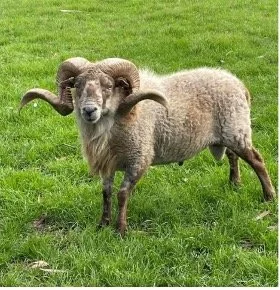
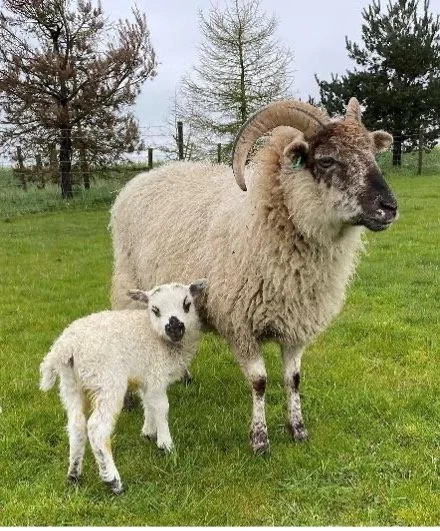
The Boreray is one of the UK’s primitive breeds and part of the Northern short-tailed group. It is a small breed with ewes weighing around 30kg and rams 45kg. The face and legs are black, tan or grey, often with dark speckles on a white background. Both sexes are usually horned, and the horns of the rams are large and spiralled; ewes may occasionally be scurred or polled.
Borerays are very hardy, will do well on sparse grazing and are able to cope with most conditions. There is also evidence that they have a high level of resistance to foot-rot and flystrike, so they are a useful breed for some grazing sites where other sheep would struggle. The breed is long-lived with ewes often lambing into their teens; average lambing percentage of lowland flocks is approximately 140%, although in upland flocks the average is less. They have very few lambing problems, and the lambs are small and lively.
Many Boreray shed their fleece naturally, allowing for it to be rooed (plucked off) rather than shorn. The wool is predominantly cream or light tan in colour, with a small proportion of sheep having grey or dark brown wool (animals can be born completely black or with large patches of black, but these usually change to cream or light tan as they mature, although occasionally these animals stay black) There is sometimes a dark rump patch, and a dark collar, particularly in rams.
For crafting, the fleece can be spun as a whole, or with the two coats separated. The fleece felts easily and takes dye well. The undercoat makes a fine and very soft yarn that can be spun for lace knitting. The outercoat alone can be spun for robust, or specialist uses such as rugs or twine. The mixed coat yarn has good definition for textured knitting.
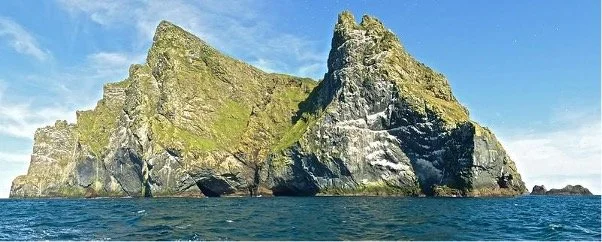
They have a close geographical and social link with Soay sheep, but the two breeds are genetically distinct with different origins. What are now known as Boreray sheep are direct descendants of the Scottish Dunface sheep that were taken to St Kilda from the highlands of Scotland, to the main and inhabited island of Hirta. Some were placed on the uninhabited island of Boreray as a feral flock. This was before 1697 when a flock of around 400 was recorded on Boreray.
Recent genetic research has shown that Boreray sheep are almost pure Dunface with a tiny input from Soay and Hebridean Scottish Blackface sheep.
When the inhabitants evacuated Hirta in 1930, all their domestic sheep were evacuated with them. The feral sheep on Boreray were left behind, and with the Scottish Dunface were recorded as extinct in 1880, the genetic findings have given them an even greater importance for Scotland.
In 1971 the first small group of seven Boreray sheep (four ewes and three rams) were taken off the island and brought over to the mainland. The descendants of these are now registered with the Rare Breeds Survival Trust (RBST). There is talk of other sheep coming off at other times and some likely contributed to the registered flocks. There is a supplementary register for a group of Boreray sheep that come from a completely separate line.
The RBST website shows Borerays as the rarest sheep breed in the UK categorized as ‘Critical’ (fewer than 300 registered breeding ewes) between 2008 and 2015. In 2015 they moved to ‘Endangered’ and in 2017-2018 they moved to ‘Vulnerable’. In the 2020-2021 RBST Watchlist, Borerays were categorised as ‘At Risk’.
Over the last five years there has been a steady decline in breeding numbers and registrations resulting in the Boreray being moved from ‘At Risk’ to the ‘Priority’ category in April 2026.