Discovering the Tweed - Part 2
When I first began dreaming about weaving St Kilda tweed on St Kilda itself, there was one rather obvious problem.
I had never actually seen a piece of it.
In fact, when I first started thinking seriously about the idea, I knew remarkably little about tweed.
In my naivety, I actually thought that if the people of St Kilda had made their own cloth, it must surely have been some form of tartan. I began searching through books on Scottish tartans, looking for a St Kildan tartan, only to discover that there didn't seem to be one.
It was only after much searching, and eventually a little more reading, that I began to understand what tweed actually was.
Even then, the idea of making St Kilda tweed myself was still little more than a thought bubble that had been floating around in my mind for some fourteen years.
Two years ago, I returned to Scotland, but the purpose of that particular visit had nothing to do with tweed.
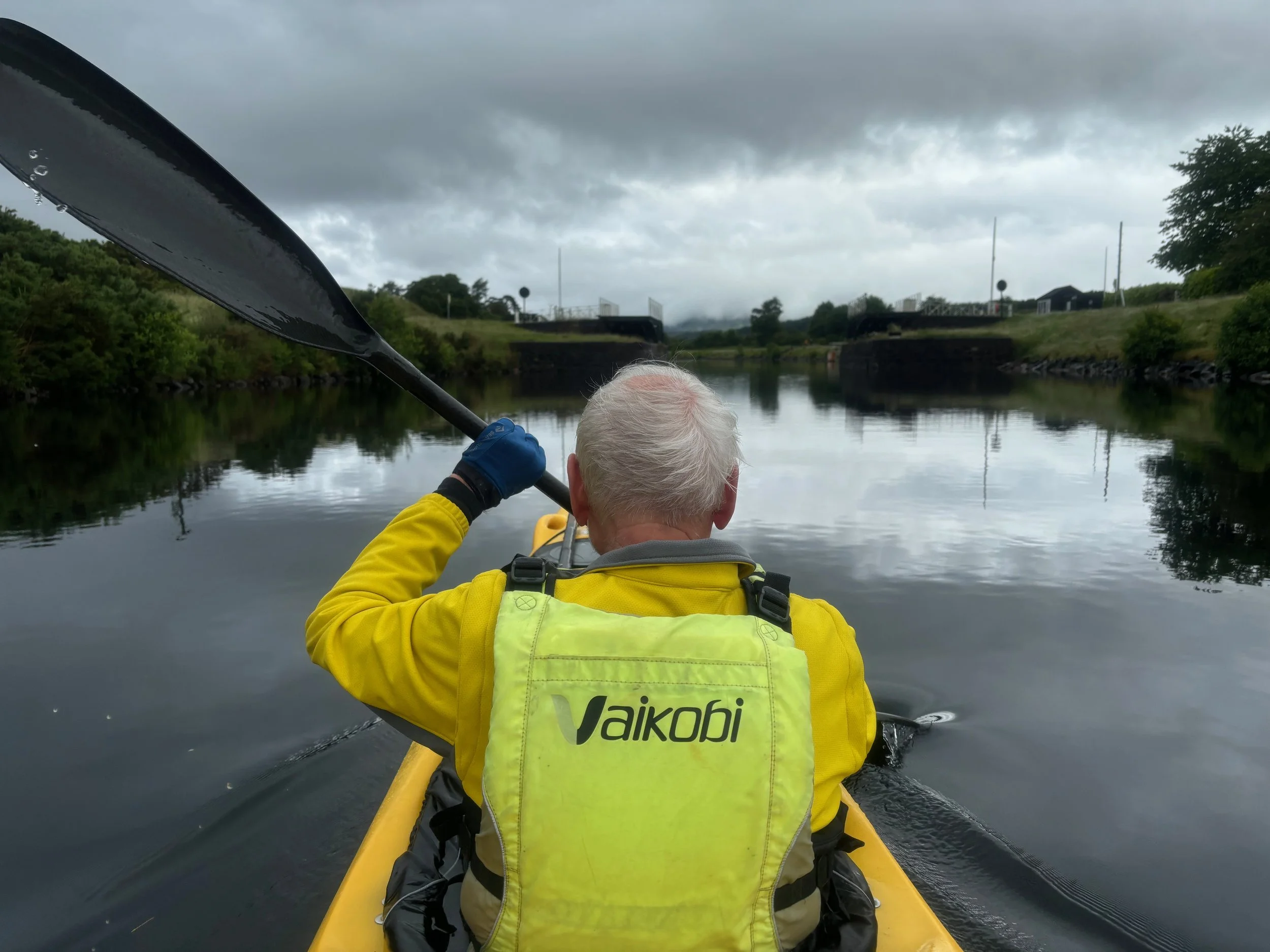
I had travelled there to kayak the Great Glen from Fort William to Inverness and, later, the Forth and Clyde Canal from the Clyde to the Falkirk Wheel. The St Kilda idea was nowhere near the centre of my plans. It was simply something I had wondered about for many years.
It was only towards the very end of my time in Scotland, when I happened to mention this rather wacky idea to my friend Jane in Tayport, that something began to change.
I don't think either of us could have imagined it at the time, but that conversation was the first real turning of the wheel.
In the last few days before I was due to fly home to Australia, I managed to squeeze in a visit to see my friend Kalie in the far north of Scotland. During our conversation, she mentioned that she had heard there was an original piece of St Kilda tweed in the Highland Folk Museum at Newtonmore, as well as another piece in the West Highland Museum in Fort William.
That immediately caught my attention.
My journey back to Glasgow would take me straight past Newtonmore, so I decided that I might as well call in and see if I could find it.
I arrived at the Highland Folk Museum with considerably more enthusiasm than knowledge.
I asked about the St Kilda tweed, but nobody seemed to know anything about it. I was told that there was a weaver working in one of the reconstructed blackhouse cottages, so I went looking for her, hoping that she might know where the piece was or be able to point me in the right direction.
Unfortunately, the weaver was nowhere to be found.
And so, after all that, I had to leave without seeing the tweed.
I returned to Glasgow still having never actually seen the cloth itself.
A few days later I flew back to Australia, with the St Kilda Tweed Project still barely more than a twinkle in my eye.
But the ball had been set in motion.
THE FIRST REAL CLUES
Eventually, after an email to the West Highland Museum, followed by a follow-up telephone call from a friend in Glasgow, the door finally opened.
The curator kindly sent me photographs of their piece of St Kilda tweed, including full-length photographs and detailed close-ups, together with its measurements.
The piece was dated to 1930 — making it potentially one of the last pieces of tweed woven on St Kilda before the evacuation of the remaining islanders in August of that year.
For the first time I could properly study the cloth.
I could see the straight twill pattern. I could see the natural colouring and the variations within the yarn. I could study the selvedges and the character of the cloth itself.
But I still had an important problem.
I didn't know how many warp threads there were to the inch.
For someone simply interested in the history of St Kilda, that might seem like a fairly insignificant detail.
For someone trying to reproduce the cloth, it was vital.
The sett — the number of threads packed into a given width — would determine the thickness of yarn I needed. It would influence the character of the finished fabric and, consequently, the way I needed to prepare the wool.
I was beginning to realise that if I was ever going to reproduce St Kilda tweed rather than simply make something that looked vaguely similar, I needed to understand every part of its construction.
And then Cecilia entered the story.
A REMARKABLE RESEARCH PARTNERSHIP
Late last year, I received an unexpected email from Cecilia, an exceptionally accomplished and experienced spinner and weaver who is undertaking a PhD on the weaving crafts of Scotland.
Originally from the United States, Cecilia now lives in Glasgow with her husband.
She had been given my contact details by Jane Cooper and tentatively introduced herself, asking whether there might be any possibility of accompanying me to St Kilda.
Given her experience and the nature of her research, I was absolutely delighted by the idea.
There was, however, one rather large proviso.
We first needed permission from the National Trust for Scotland.
Accommodation on St Kilda is limited and highly sought after, and there was certainly no guarantee that permission would be granted for Cecilia to accompany me.
From that point onwards, we both began corresponding with the NTS, sometimes waiting for months without knowing whether our request would ultimately be successful.
But Cecilia did something that proved invaluable.
While we waited, she began investigating the surviving evidence.
She visited collections containing St Kildan artefacts, including the West Highland Museum in Fort William, the Highland Folk Museum in Newtonmore and the National Trust for Scotland archives in Dunfermline.
Because of her extensive knowledge of textiles and spinning, she was able to look at the surviving pieces in a way that I simply could not have done on my own.
She sent me photographs of the artefacts, often with close-ups of the fibres and, critically, a ruler placed across the cloth.
Suddenly, we had something far more useful than photographs taken simply to show what the tweed looked like.
We could begin to measure it.
We could study the yarn.
We could examine the weave.
And gradually, the cloth began to reveal its secrets.
RECONSTRUCTING THE CLOTH
One of the most significant discoveries was that the yarn was single-ply.
That was important because I was now trying to work backwards from the surviving fabric to determine how the original islanders might have produced it.
The photographs and measurements also helped us establish the approximate sett and gave us a much better understanding of the thickness and character of the yarn.
Then there was the wool itself.
Everything we were learning increasingly supported what we had suspected: that the warp had been made from Boreray wool and the weft from Soay.
There was a practical reason for this.
Soay wool has a relatively short staple and therefore doesn't have the same tensile strength as the longer-stapled Boreray wool. The warp has to withstand considerable tension during weaving, so the stronger, longer Boreray fibre made sense for that purpose, while the softer, more variable brown tones of the Soay wool created the characteristic appearance of the weft.
Piece by piece, the picture was becoming clearer.
This was no longer simply a piece of old cloth in a museum.
It was the result of a particular sheep population, particular fibres, particular spinning techniques and particular weaving practices.
And Cecilia's expertise was invaluable in helping me understand all of those connections.
FINALLY SEEING THE CLOTH FOR MYSELF
Eventually, during my recent trip to Scotland, I was finally able to visit the West Highland Museum in Fort William.
It was one of the highest priorities of my entire journey.
I drove the two-and-a-half hours from Buchlyvie to Fort William, travelling through the extraordinary landscape of Glen Coe, to meet Venessa, the Curator, and examine the surviving piece of St Kilda tweed for myself.
Until that moment I had only ever seen it in photographs.
Nothing compared with standing in front of it.
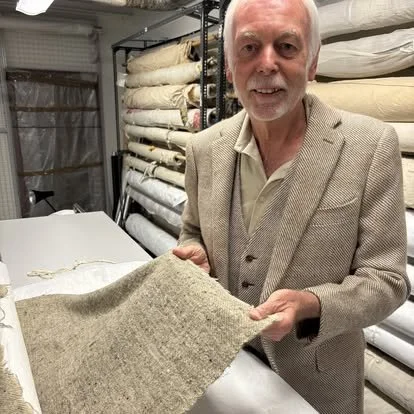
I was able to examine the cloth closely, studying everything from the beautifully executed selvedges to the character of the hand-spun warp and weft yarns.
Most importantly, I could finally appreciate its texture and handle.
It was considerably rougher than the tweed I had woven myself from much softer Corriedale wool.
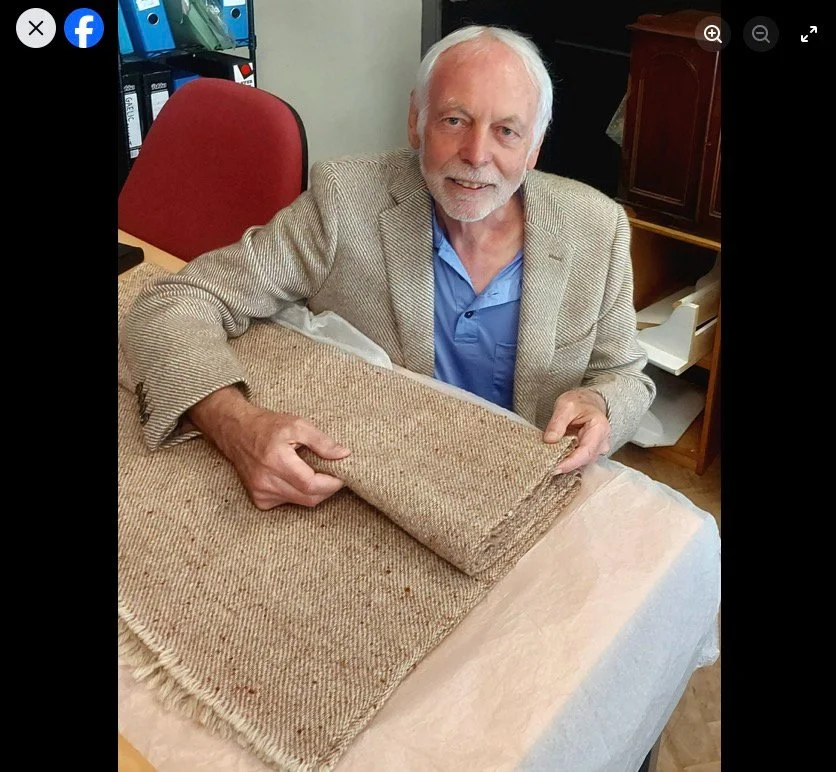
One of my photographs shows my own tweed jacket beside the original St Kilda cloth.
The comparison was fascinating.
My Australian-made tweed was softer and more refined, while the original St Kilda cloth had a much more robust and almost primitive character.
It was precisely this difference that made the experience so valuable.
I wasn't looking at something I merely wanted to imitate anymore.
I was looking at the standard I would eventually have to try to reproduce.
NEWTONMORE
The following day I travelled to the Highland Folk Museum at Newtonmore, where I was privileged to meet Helen, the Collections Curator.
This time I was able to examine a remarkable collection of St Kildan artefacts.
Among them was a 3.48-metre length of original St Kilda tweed woven in 1925.
There was also a traditional puffin trap, a horsehair rope used by the islanders to descend the towering cliffs to catch seabirds and collect their eggs — apparently one of only three surviving examples — and a wonderfully simple bobbin winder, most likely made from driftwood washed ashore on the island.
It was extraordinary to see these objects together.
The tweed itself provided another opportunity to compare surviving examples.
The similarities between this piece and the one I had examined at Fort William were immediately apparent: the natural colouring, the distinctive texture and the neatly woven selvedges.
But there were also differences.
This example appeared slightly less consistent, with small variations in the twill and in the edges of the cloth.
Cecilia had often suggested that the quality of weaving on St Kilda would inevitably have reflected the experience and skill of the individual weaver.
Standing there looking at two surviving pieces made perhaps five years apart, I could begin to understand exactly what she meant.
These were not factory-produced lengths of cloth.
They were handmade.
And behind each one was a particular person, working with the materials available to them on a remote island in the Atlantic.
The photographs also made another comparison possible.
Beside the original St Kilda tweed was my own suit, woven from Australian Corriedale wool.
The difference in colour, texture and handle was striking.
My tweed was softer and paler, while the original cloth had that unmistakable character created by the Soay wool in its weft.
It made me even more excited to discover what would happen when I eventually wove with genuine Soay and Boreray wool.
THE SUIT IN STORNOWAY
There was still one more piece of the puzzle that I desperately wanted to see.
A jacket and waistcoat held by Stornoway Museum on the Isle of Lewis, believed to be perhaps the only surviving garments made from St Kilda tweed.
Getting there was an adventure in itself.
I drove for four hours to Ullapool before boarding the ferry for the two-and-a-half-hour crossing to Stornoway.
When I finally arrived at the museum, however, things did not go according to plan.
A fire alarm was sounding and visitors and staff were gathered outside.
While we waited, I spoke with Caroline, the Archives Officer, and explained my project and my hope of seeing the suit.
Then came the news I had been dreading.
The only person with access to the store where the garments were kept was away on holiday.
There was no way for me to see them.
I was devastated.
I had only just managed to fit this visit into an already hectic Scottish itinerary before returning to Australia, and this was something I had been longing to see.
Caroline suggested that I send an email to the museum office anyway. There was perhaps one other person, Samantha, who might be able to help, although Caroline wasn't optimistic that she could be contacted.
I sent the email and reluctantly went off to check into my accommodation, resigned to returning to Glasgow the following morning without having seen the suit.
Then, just an hour later, everything changed.
Samantha emailed me.
Caroline had managed to contact her and tell her about My St Kilda Tweed Project. Samantha kindly offered to come into the museum the following afternoon so that I could see the garments.
I was absolutely overjoyed.
Without hesitation, I extended my stay in Stornoway by another night and changed my ferry booking.
The following day I finally stood before the jacket and waistcoat.
Once again, something I had previously known only through photographs was suddenly there in front of me.
I was able to photograph the garments extensively and examine them in minute detail.
It was an extraordinary privilege.
I cannot thank Caroline and Samantha enough. They both went well beyond what could reasonably have been expected of them to make this possible. Their kindness and willingness to help someone who had travelled from the other side of the world meant more to me than they could possibly know.
FROM UNDERSTANDING TO RECREATING
By now, the picture was beginning to come together.
I had seen surviving pieces of the cloth.
I had examined different examples from different periods.
I had studied the weave, the yarn and the selvedges.
With Cecilia's help, I was beginning to understand the relationship between the Soay and Boreray fibres and the way they had been used.
And now I had seen what the cloth looked like when transformed into garments.
The jacket and waistcoat gave the whole project another dimension.
I could now imagine the cloth not simply as something on a museum shelf, but as something that had once been worn by a real person.
That thought made the project feel even more tangible.
My hope is now to weave enough authentic St Kilda tweed, using wool from Soay and Boreray sheep, for my tailor in Australia to recreate a jacket and waistcoat in the same style.
And if, one day, the finished garments are worthy of the original, I would love to donate them to the National Trust for Scotland as a small gesture of gratitude for the encouragement and support they have given me throughout this extraordinary journey.
Looking back, I realise that discovering St Kilda tweed has been rather like putting together a very old and incomplete jigsaw puzzle.
One museum provided a piece.
Another provided another.
A photograph revealed something hidden in the yarn.
A measurement answered a question.
Cecilia's expertise helped interpret what we were seeing.
And every new discovery led to another question.
But slowly, the picture emerged.
I began this journey knowing that I wanted to weave St Kilda tweed on St Kilda.
I now had a much clearer understanding of what that actually meant.
The cloth wasn't simply tweed.
It was the physical expression of an island, its sheep, its people, their skills and the materials that surrounded them.
And if I was going to bring that craft back to St Kilda after almost a century, I would have to start not with the loom, but with the wool.
The next stage of the journey had begun.