Learning to Weave - Part 4
By this stage, the idea of weaving St Kilda tweed had been with me for some time. I had seen photographs of the surviving cloth at the West Highland Museum in Fort William, begun researching how it might have been made and started looking for the wool. But there was one fairly obvious problem: I didn't know how to weave.
The interesting thing was that, at this stage, I had no certainty that the project would ever actually happen. I was simply following my nose. One door opened, so I walked through it. Then another appeared, and I walked through that one too. I was preparing for something that might never happen. Perhaps, in retrospect, it was an act of faith.
FINDING A TEACHER
My introduction to weaving came through a visit to the wool show at the Bendigo Showgrounds almost immediately after returning to Australia. It was there that I met Paula, who told me about Ilka. I contacted Ilka, and she became my teacher. That was the beginning of my practical education in weaving.
There was a lot to learn, of course, but I wasn't interested in becoming an all-round weaver. I had a very specific objective. I wanted to weave St Kilda tweed. That was it. Tweed, tweed and more tweed.
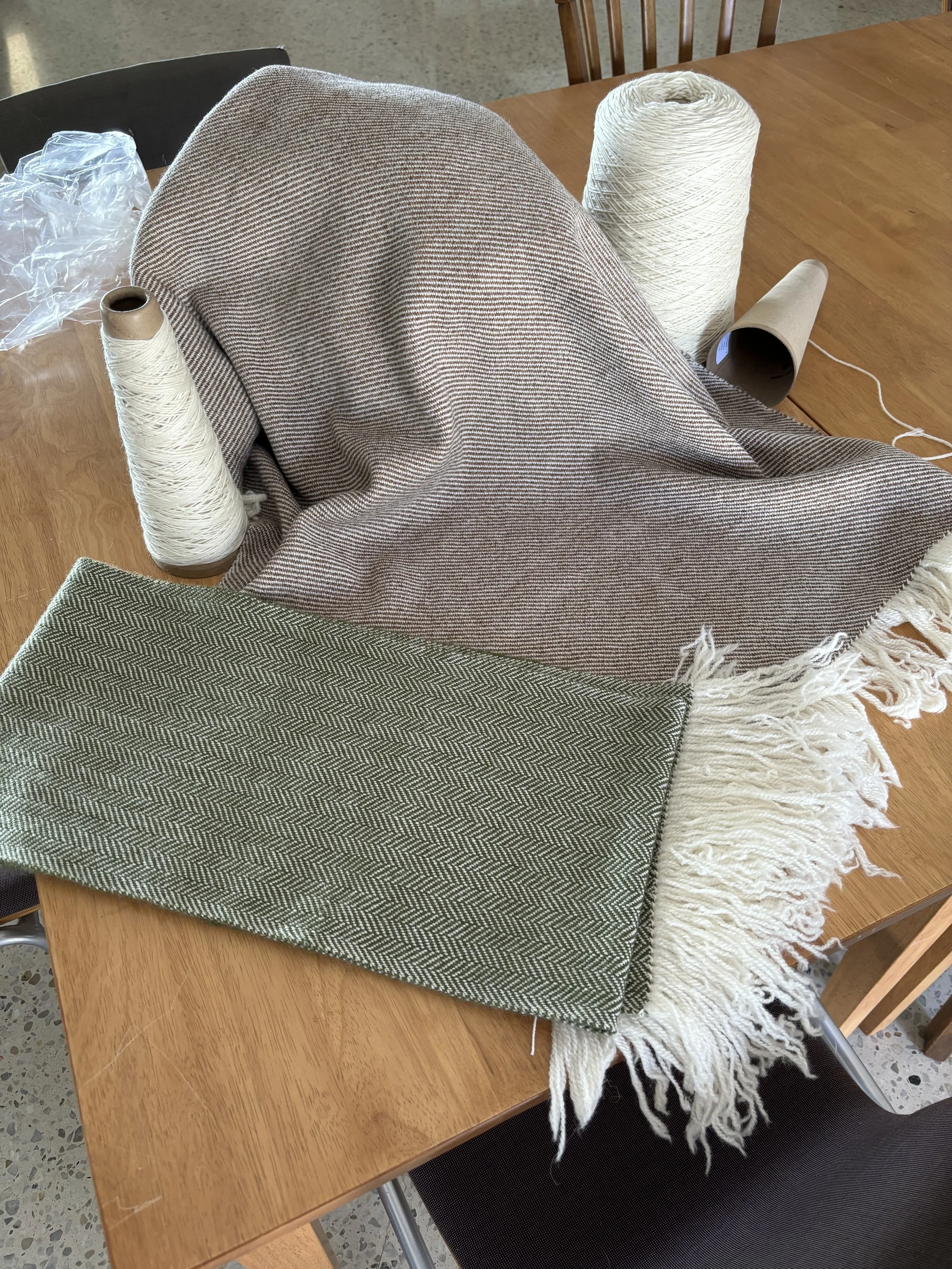
I wasn't particularly interested in experimenting with lots of different colours or complicated patterns. I wanted to learn how to set up a loom properly and become sufficiently competent at weaving the simple 2/2 twill that I believed represented the structure of the original St Kilda cloth. So that was what I concentrated on.
I wove it again and again and again. I wanted to become comfortable with the entire process of setting up the loom, getting the warp right, maintaining the tension and producing an even, consistent piece of cloth. There was no shortcut. I simply kept weaving.
Eventually, I began to feel comfortable with both the setting up of the loom and the quality of the work I was producing. That was the point I needed to reach, not because I wanted to call myself a weaver, but because if the St Kilda project ever became a reality, I needed to know that the weaving itself wouldn't be the thing that stopped me.
AN EXTRAORDINARY MEETING
Then, on the fifth Saturday of my weaving course with Ilka, something happened that I still find difficult to describe as simply a coincidence.
Ilka had invited some of her former students to come along for afternoon tea with us and to share what they had been doing since completing their previous weaving course. When the time came, she had arranged twenty-five or thirty chairs in a circle, and I simply chose one at random and sat down.
The person to my left was already talking with someone beside her, but Sandra, who was sitting on my right, kindly started a conversation by asking what my interest in weaving was.
When I began to tell her about my project, she almost fell off her chair.
Her ancestors were from St Kilda.
I could hardly believe it. Here I was, sitting in Australia, learning to weave because I had become almost obsessively determined to one day weave St Kilda tweed on St Kilda itself, and by what appeared to be nothing more than chance, I had chosen a chair beside someone whose own family had come from the very island I was trying to return to.
Think of the chances. The timing. The seemingly random set of circumstances that had brought us together. And, as if that wasn't remarkable enough, Sandra lived in Bendigo, not far from my own home.
I hadn't gone looking for Sandra. I hadn't gone looking for anyone with a St Kilda connection. She had simply been invited back to spend an afternoon with Ilka and some of her former fellow students. I had simply sat down in a particular chair. Yet there we were, sitting beside each other, and within minutes I had discovered this extraordinary connection.
It gave me an enormous boost. Until then, I had been learning to weave because I needed to be ready if the opportunity ever came. But meeting Sandra made the whole idea feel somehow more real. It was another of those moments when I began to wonder whether this project was not quite as unlikely as it had seemed when I first dreamed it up.
Sandra subsequently loaned me a number of books about St Kilda, which helped to build my still limited knowledge of the island and its people. She also shared her family's story of their journey to Australia aboard the barque Priscilla in 1852, funded by the Highland and Island Emigration Society.
The voyage was catastrophic. Disease swept through the ship, and only seventeen of the thirty-six islanders survived the voyage and subsequent quarantine in early 1853. Listening to Sandra tell the story brought the history of St Kilda into a much more personal focus for me. These were no longer simply names and events I was reading about in books; they were the experiences of someone's own ancestors, passed down through her family.
Sandra, a former journalist, later wrote a wonderful letter of support to accompany my submission to the National Trust for Scotland.
Looking back, it is difficult not to see how one event seemed to lead quietly to another. A visit to a wool show had introduced me to Paula. Paula had introduced me to Ilka. Ilka had taught me to weave. Then, quite by chance, I had sat beside Sandra, whose family history was rooted in St Kilda and whose books, knowledge and encouragement helped deepen my understanding of the island.
It was another of those moments that gave me confidence that perhaps this unlikely idea might actually have a life of its own.
I still didn't know where it would lead, and I certainly didn't know whether I would ever receive permission to go to St Kilda. But I do know that meeting Sandra gave me a massive impetus to continue. I went back to my loom with even greater determination. I was going to learn how to weave, and I was going to be ready.
THE FIRST LOOM
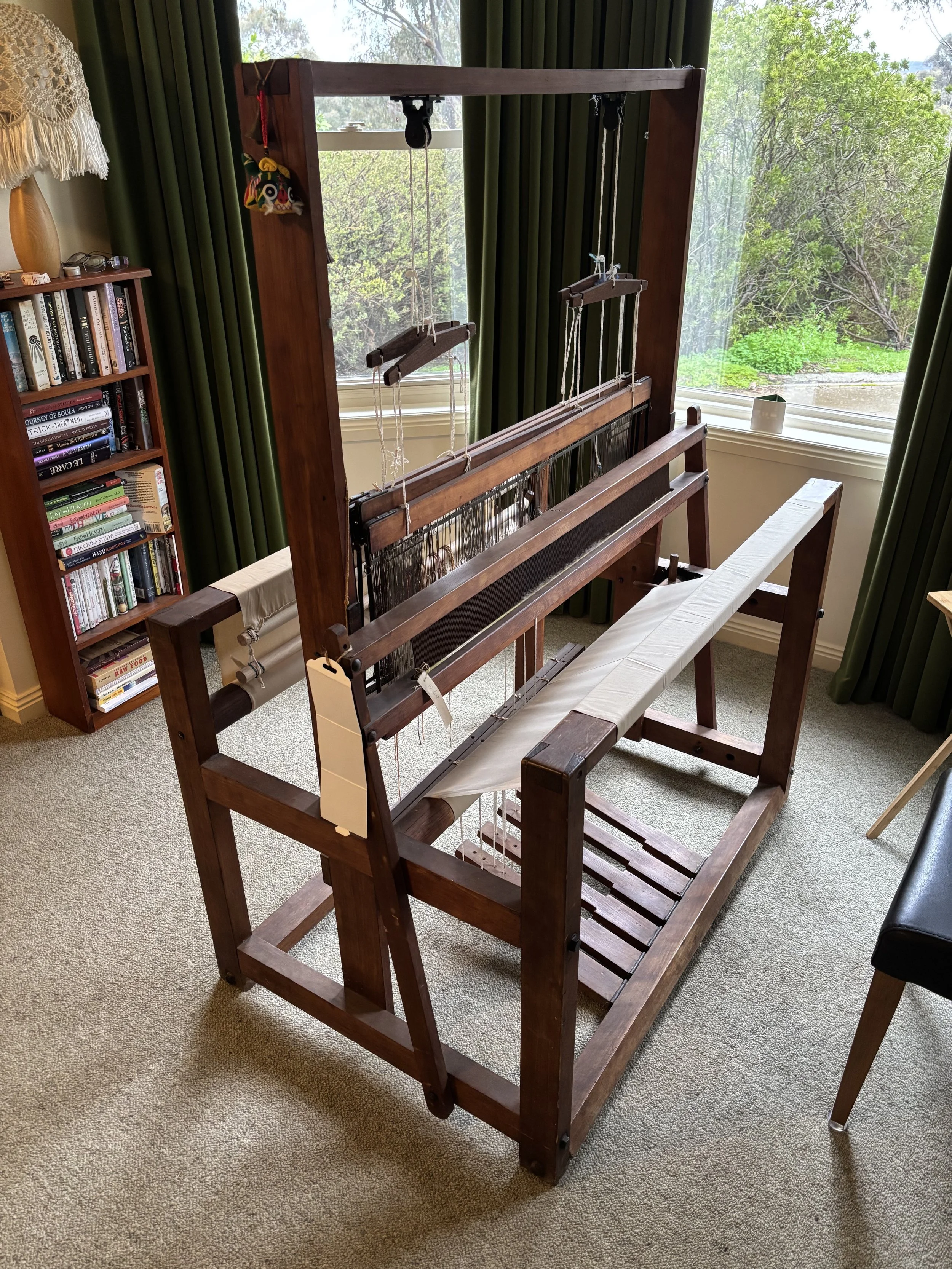
As I became more involved in learning to weave, I purchased a floor loom similar to the ones used on St Kilda from Shalome in Ballarat. For the time being, that was exactly what I needed. It allowed me to practise properly and gave me the opportunity to spend the time necessary to become confident in what I was doing.
But I still had no idea whether I would ever actually use those skills on St Kilda. The entire project depended on something that was completely outside my control. I needed permission from the National Trust for Scotland.
Until that happened, everything I was doing was preparation for something that might never happen. I could learn to weave. I could buy a loom. I could research the cloth. I could investigate the wool. But none of it guaranteed that I would ever stand on the island with a loom in front of me.
So I simply kept going. I followed each lead as it appeared and dealt with each problem when it arose.
THE MOMENT EVERYTHING CHANGED
Eventually, I applied to the National Trust for Scotland for permission to undertake the project on St Kilda.
And then I had to wait.
Until that point, the whole thing had existed somewhere between an ambition and a possibility. I had been preparing myself for something that might never happen, never knowing whether all the work I was putting into learning to weave, researching the cloth and finding the wool would ultimately lead anywhere.
Then the answer came.
Permission was granted.
That was the moment when everything changed.
Until then, I had been preparing for something that might never happen. Now I knew it was actually going to happen.
And almost immediately, the questions changed. It was no longer simply, "Can I learn to weave?" It became, "How am I actually going to get a loom onto St Kilda?"
FINDING THE RIGHT LOOM
The floor loom I had purchased was useful for learning and for developing my weaving skills, but it was never going to be the loom I took to St Kilda.
There were practical considerations that simply couldn't be ignored. I would have to get the loom from Australia to Scotland. Then Cecilia and I would have to take it with us on a relatively small boat to St Kilda. Once we arrived, our equipment would have to be transferred from the boat to a small dinghy for the trip to the wharf.
A large floor loom was simply not practical.
So I started looking for something much smaller and, importantly, something that could be folded and transported.
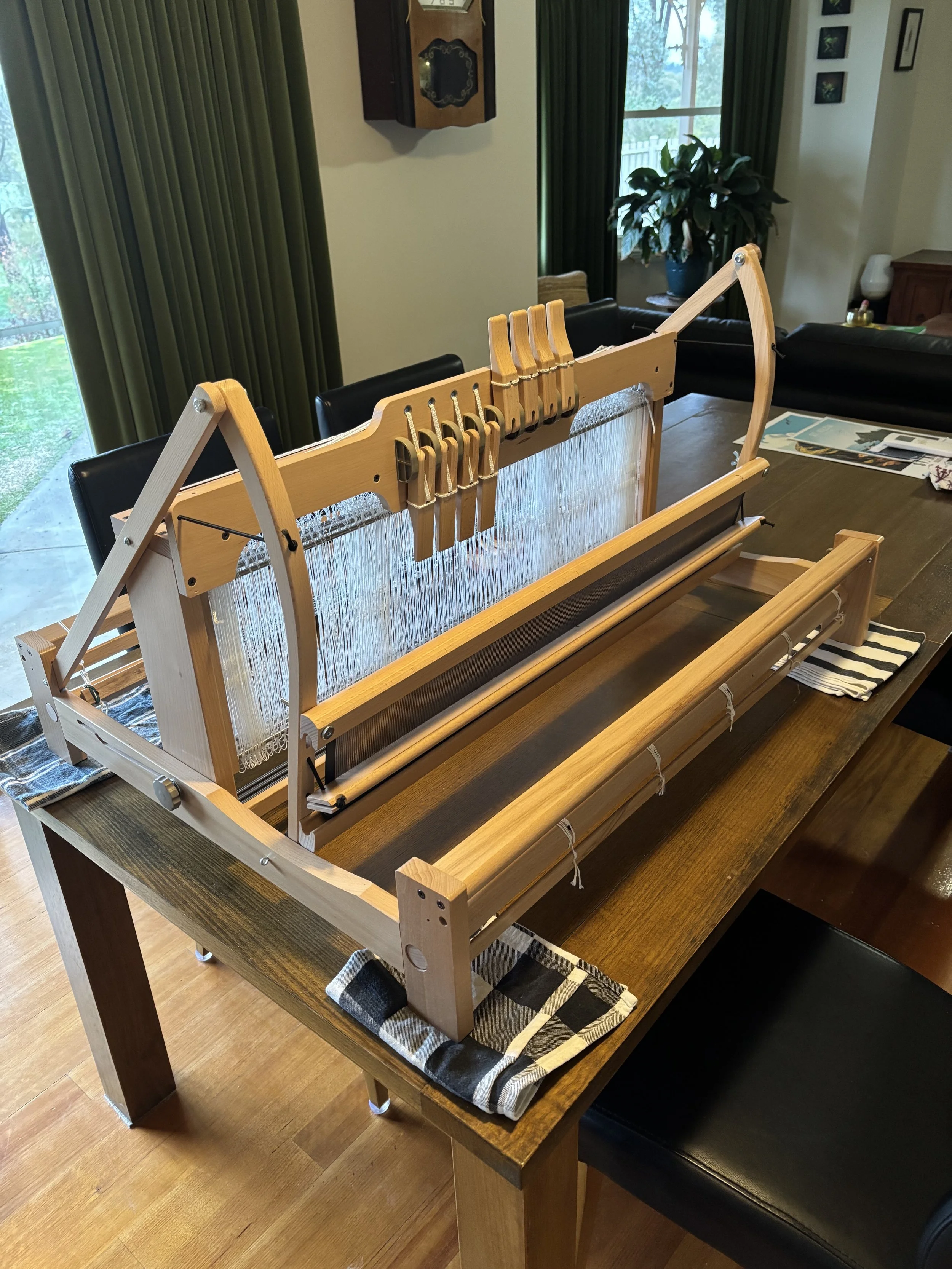
About twelve months after my first visit to the wool show, I went back again. This time I saw an Ashford folding table loom being demonstrated. It was an 80-centimetre loom, and as soon as I saw it, I knew I had found what I was looking for. I put in an order immediately.
It wasn't simply another loom. This was the loom that had a realistic chance of making the journey with me to St Kilda.
There was another reason why the 80-centimetre width suited the project. The surviving piece of St Kilda tweed at the West Highland Museum is approximately 76 centimetres wide. My intention was therefore to weave the new cloth at approximately the same finished width.
The Ashford gave me sufficient width to do that while still being compact enough to transport. For the first time, I could begin to picture the practical reality of taking the loom to the island.
THE WOOL BECOMES REAL
The granting of permission also changed the way I thought about the wool.
Until then, buying large quantities of Soay fleece from Cheryl had been more of a tentative possibility. Now I knew I was going to need it. I began to firm up the arrangements with Cheryl for the Soay fleece.
And then another problem became much more urgent.
Where on earth was I going to find the Boreray wool?
I already understood that the historical cloth appeared to involve two different breeds: Soay for the weft and Boreray for the warp. Finding the Soay had become possible. Finding the Boreray was going to be much harder.
And so another door opened.
Cheryl told me about Jane Cooper and her book The Lost Flock, which tells the remarkable story of the Boreray sheep. I bought the book and contacted Jane.
Jane put me in touch with Marianna at the Kirkwall Museum, and Marianna put me in touch with Hazel at Airy Farm on Stronsay. Once again, another door opened, as Hazel said yes, she was able to supply me with the amount of Boreray fleece I required.
PREPARING FOR ST KILDA
Looking back, I can see that this was the point when the project began to change from an idea into something practical. But it didn't happen all at once. There was no master plan. I wasn't sitting down with a list of everything that needed to be achieved.
I was simply following my nose.
One person introduced me to another. One problem led to another question. One answer opened another door. And gradually, the project began to take shape.
Learning to weave had been one of the first things I had needed to do. Meeting Sandra was one of those extraordinary moments that made me believe, perhaps for the first time, that this unlikely idea might actually have a life of its own. Finding a loom that could actually travel to St Kilda was another. Finding the wool was another.
And now the possibility of obtaining both Soay and Boreray fleece meant that the raw materials were beginning to become a reality as well.
I still had a great deal to learn, but the most important thing had changed. I was no longer simply dreaming about weaving St Kilda tweed. I was preparing to do it.
The loom would have to make the journey. The wool would have to become yarn. The yarn would have to become cloth. And somehow, all of the decisions I had made by simply following the next open door had brought me to the point where that no longer seemed impossible.
There was still a long way to go. But the more I followed those unexpected connections, the more I began to believe that perhaps this really was going to happen.
And meeting Sandra, on that fifth Saturday of my weaving course, was one of the moments that gave me the confidence to keep going with even more determination.
At that stage, I still didn't know whether the National Trust for Scotland would ever give me permission. But something inside me had changed. I no longer felt as though I was simply learning to weave in the hope that one day I might go to St Kilda.
I was learning to weave because, somehow, I had begun to believe that I might actually get there.
And that belief gave me an enormous impetus to continue.
With even more vigour. Tweed, Tweed and more tweed