The Value of St Kilda Tweed
Over the past few days I've been reading The Gravity of Feathers by Andrew Fleming, and it has revealed some fascinating insights into the story of St Kilda tweed.
Until now I had tended to think of St Kilda tweed as a tradition stretching back through the centuries. Instead, the evidence suggests that what we now recognise as St Kilda tweed was actually a relatively short-lived phenomenon. It appears to have begun in the early 1860s, following the construction of the new village on Hirta, and came to an abrupt end in 1930 with the evacuation of the last islanders. In all, this extraordinary cloth was produced for less than seventy years.
The book also traces an interesting evolution in the weaving itself. Earlier generations of St Kildan women wove on upright looms, and the 1851 census records many unmarried women and widows simply as "weaveresses." As the new cottages were built in the early 1860s, treadle looms seem to have been introduced, and over time the men increasingly took on the weaving, while the women continued the equally demanding work of preparing the wool.
By the 1870s, weaving had become a major part of island life. Visitors described both men and women working from dawn until late into the night to produce cloth. By 1882 St Kilda tweed was being praised as "capitally woven and good-looking," and demand continued to grow.
The figures are remarkable. Between 1874 and 1883, the income earned from tweed increased tenfold, and by 1890 it was already being described as "of superior quality." By 1908 demand had exceeded supply, and a special trademark had been registered to distinguish genuine St Kilda tweed from every other fabric.
What made it unique was not simply the quality of the weaving. Every stage of its production remained entirely by hand. The wool came only from sheep grazing on Hirta. It was hand prepared, hand spun and hand woven. There was no machine carding and no mill spinning. Every length of cloth carried within it the landscape, the sheep and the hands of the islanders themselves.
Perhaps the most revealing passage in the book describes why St Kilda tweed became so highly prized. Only twelve to fifteen weavers were producing it, on primitive looms, using wool from a tiny island whose sheep numbers were naturally limited by the available grazing. In today's language, it was the ultimate "limited edition."
Its rarity, combined with the romance and remoteness of St Kilda, gave the cloth an almost mythical reputation. It became the tweed sought after by sportsmen, travellers and those who appreciated exceptional craftsmanship—not because it was fashionable, but because it represented something authentic that could never be mass produced.
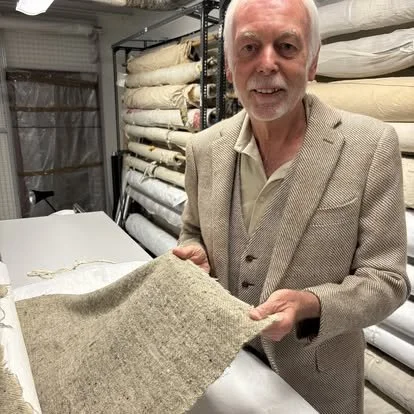
Reading these accounts has made me appreciate even more the privilege of attempting to weave St Kilda tweed once again. My goal has never been simply to reproduce an old fabric, but to understand the skills, the materials and the lives of the people who created it.
The more I learn, the more extraordinary their achievement becomes.