The Loom that must Cross the Sea - Part 9
When I first imagined returning to St Kilda to weave its tweed, I pictured myself sitting at a loom somewhere near Village Bay, passing the shuttle back and forth as the cloth slowly grew beneath my hands.
It was a compelling image—but before it could become reality, there was a decidedly practical question to answer.
How do you carry a loom across the Atlantic and land it safely on St Kilda?
The St Kildans themselves used floor-standing looms. These were relatively simple four-shaft looms, capable of producing the straightforward 2/2 twill from which their tweed was woven. They could also produce cloth approximately 76 centimetres wide—the same width found in the surviving lengths I examined at the West Highland Museum in Fort William and the Highland Folk Museum in Newtonmore.
Taking a similar floor loom back to the island, however, was never going to be practical.
Everything required for the project must travel by sea aboard Enchanted Isle, operated by St Kilda Sea Tours. The crossing takes approximately two and a half hours and passes through waters fully exposed to the Atlantic. Sailings are entirely dependent upon the weather and sea conditions, and even after reaching Village Bay, the journey is not quite over.
The boat cannot simply draw alongside the pier and unload.
Passengers and equipment must make the final short—but significant—journey from Enchanted Isle to the St Kilda pier in a small dinghy. I remember that transfer well from my first visit to the island. Even on a favourable day, it makes very clear that everything taken ashore must be compact, manageable and capable of being safely lifted from one moving vessel to another.
A conventional floor loom would be far too large and cumbersome.
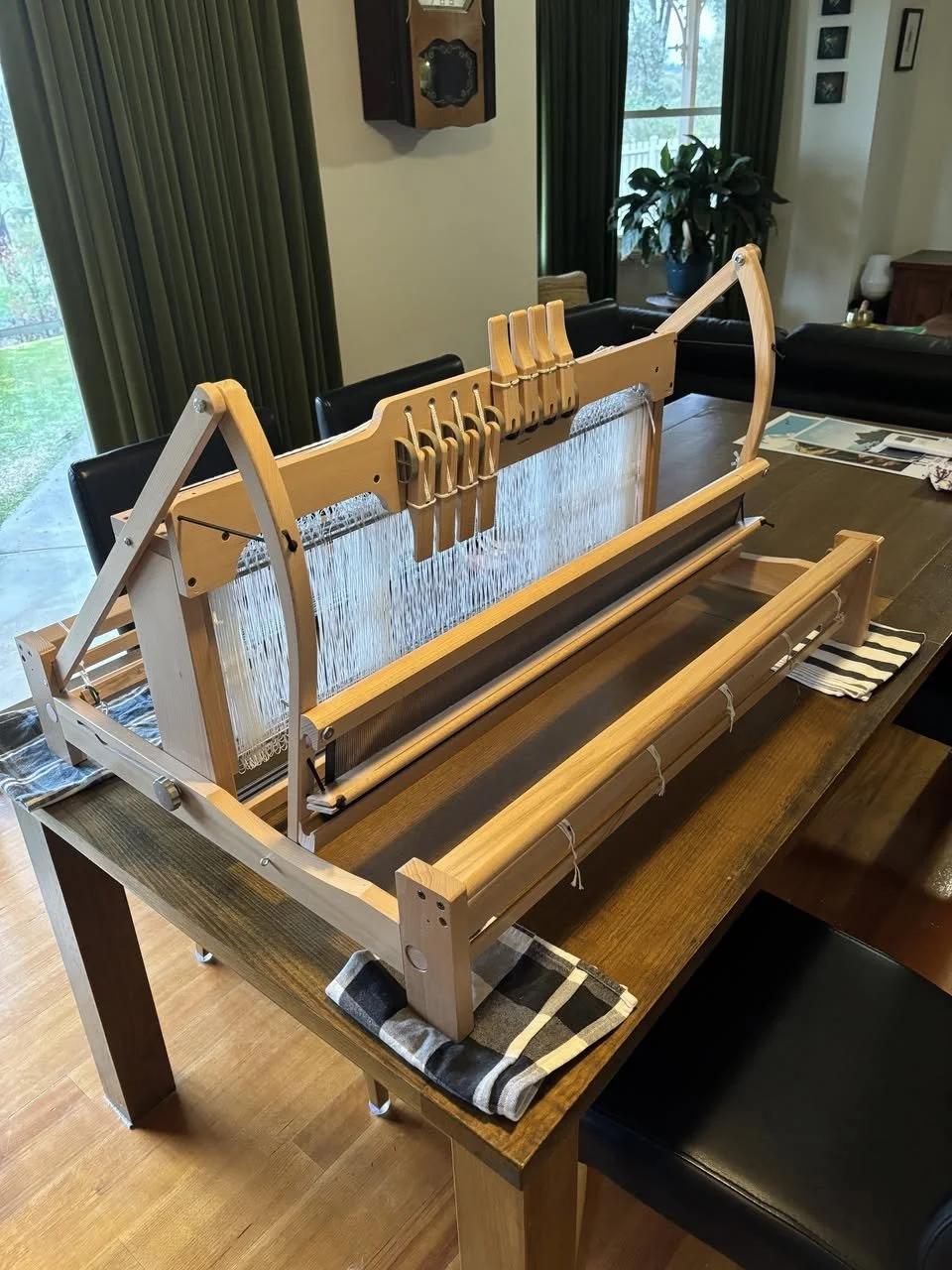
The answer was an Ashford 80-centimetre, eight-shaft folding table loom.
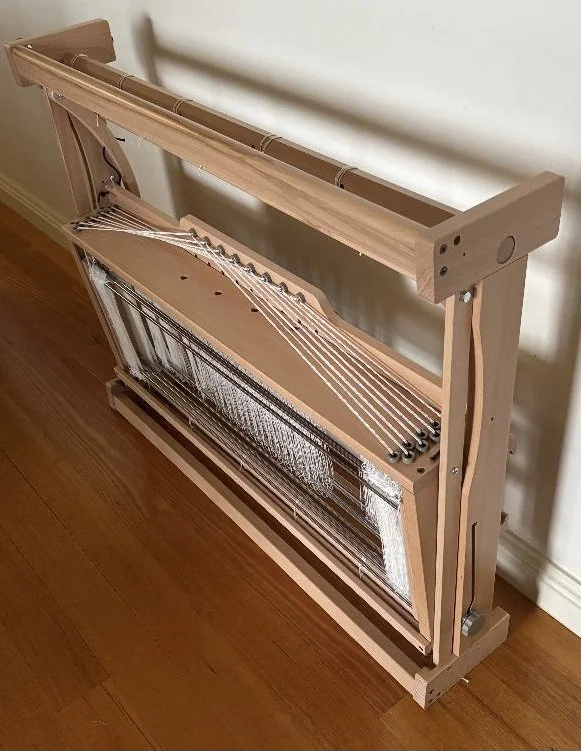
Its weaving width is particularly important. At 80 centimetres, it is wide enough for me to reproduce the approximately 76-centimetre width of the surviving St Kilda cloth. Yet, when folded, the loom is only about 18 centimetres high, 74 centimetres deep and 96 centimetres wide. It weighs approximately 12.3 kilograms.
It is, in other words, a full-width working loom that can be folded into something compact enough to cross the Atlantic and be carried ashore by dinghy.
Although this is an eight-shaft loom, I will use only four of its shafts. The additional shafts make the loom capable of weaving far more elaborate patterns, but elaborate patterning is not the purpose of this project. My intention is to weave the simple 2/2 twill used by the St Kildans, and four shafts are all that is required.
The loom therefore brings certain modern practical advantages without changing the fundamental structure of the cloth I intend to weave.
Its compact design does impose one important limitation. Because there is only about five centimetres of clearance around the front and back cloth rollers, there is a limit to the amount of bulky woollen cloth that can be wound onto them.
I have experimented with yarn of a thickness comparable to that used in the original St Kilda tweed and have found that the maximum practical length I can weave on the loom at one time is approximately five metres.
That limitation has helped determine the dimensions of the cloth I will produce. The loom has not merely been selected to carry out the project; its physical characteristics have become part of the project’s design.
There is another reason why its ability to fold is so valuable.
When I first applied for permission to undertake the project, I requested a stay of six weeks on St Kilda. The National Trust for Scotland was instead able to grant me four weeks. I am enormously grateful for that time, but the reduction means that every available weaving day will be precious.
Preparing a loom of this width is not a quick undertaking. The hundreds of individual warp threads must be carefully measured, arranged in their correct order, passed through the heddles and reed, secured to the loom and brought under even tension. Working carefully, the process could consume as much as three days of my limited stay.
Fortunately, the Ashford loom can be folded with a warp already in place.
I have therefore decided to prepare the first warp, using the machine-spun yarn from the Border Mill, before leaving for St Kilda. The loom will cross the sea fully warped and ready for weaving.
This will require particular care. The warp must remain secure and evenly tensioned while the folded loom is transported by road, loaded aboard Enchanted Isle, carried across the Atlantic and finally transferred into the dinghy for the landing at Village Bay.
But if all goes according to plan, once the loom and our equipment have been carried ashore, I will be able to unfold it, set it up and begin weaving almost immediately.
There will be something deeply symbolic in that moment.
The loom will arrive on Hirta folded and silent, but already holding hundreds of carefully ordered threads. Once opened, those threads will become the foundation of a new length of St Kilda tweed.
The loom is not historically identical to those once used in the island cottages. It was never intended to be. It is the practical means by which I can recreate their work under very different circumstances: wide enough to reproduce their cloth, simple enough to use only the four shafts their twill requires, compact enough to travel in a small boat and light enough to be carried ashore by dinghy.
For me, it has become far more than a piece of equipment.
It is the loom that must cross the sea—and, if the Atlantic allows us passage, it will carry the beginnings of St Kilda tweed home.